Mounjaro vs Generic Semaglutide for Type 2 Diabetes: Which Should You Choose?
Key Takeaways
- Mounjaro (tirzepatide) acts on two gut hormone receptors, GIP and GLP-1. Semaglutide acts on GLP-1 alone.
- In the SURPASS-2 trial, Mounjaro lowered A1C by 2.0% to 2.3%, compared with 1.9% for semaglutide 1 mg.
- Semaglutide is FDA-approved to lower heart and kidney risks in type 2 diabetes. Mounjaro gained its heart risk approval in August 2026.
- Generic semaglutide is approved by Health Canada, not the FDA. There is no generic Mounjaro in the US or Canada.
Mounjaro lowered A1C and weight more than semaglutide in a head-to-head trial, but generic semaglutide costs far less, and its active ingredient carries FDA-approved heart and kidney benefits. For people with type 2 diabetes, that trade-off shapes the Mounjaro vs generic semaglutide decision. Here's how the two compare on results, safety, and price.
How Mounjaro and Generic Semaglutide Differ
The core of tirzepatide vs semaglutide is how many hormone signals each drug copies. Semaglutide mimics GLP-1, which boosts insulin when blood sugar is high, lowers glucagon, and slows digestion. Tirzepatide mimics GLP-1 and a second gut hormone, GIP, which adds to the insulin response. Generic semaglutide contains the same molecule as Ozempic, so most Mounjaro vs Ozempic data for type 2 diabetes applies to it too.
| Feature | Mounjaro | Generic Semaglutide |
|---|---|---|
| Active ingredient | Tirzepatide | Semaglutide (same as Ozempic) |
| Hormones targeted | GIP and GLP-1 | GLP-1 |
| Maker | Eli Lilly | Apotex and Dr. Reddy's |
| Approved by | FDA | Health Canada (not FDA) |
| Weekly dose range | 2.5 mg to 15 mg | 0.25 mg to 1 mg |
| Missed dose window | Up to 4 days late | Up to 5 days late |
| Approved ages | Adults and children 10 and older | Adults |
| Heart and kidney approvals (US label) | Lowers heart attack, stroke, and heart death risk in high-risk adults | Lowers heart risk in adults with heart disease and slows kidney decline in chronic kidney disease (Ozempic label) |
| Generic version | None | Available in Canada |
← Swipe to see more →
Brand Ozempic goes up to 2 mg a week. The Canadian generic pens currently cover doses up to 1 mg, which is the same dose Mounjaro was tested against in its main head-to-head trial.
Mounjaro vs Generic Semaglutide: A1C and Weight Results
The best direct comparison is SURPASS-2, a 40-week trial in adults with type 2 diabetes already taking metformin. Everyone started with an average A1C of 8.3%, and the comparison arm used semaglutide 1 mg, the same top dose as the generic pens.
| Weekly Dose | A1C Change | Reached A1C Under 7% | Weight Change |
|---|---|---|---|
| Semaglutide 1 mg | -1.90% | 79% | -5.7 kg (about 12.6 lbs) |
| Mounjaro 5 mg | -2.00% | 82% | -7.6 kg (about 16.8 lbs) |
| Mounjaro 10 mg | -2.20% | 86% | -9.3 kg (about 20.5 lbs) |
| Mounjaro 15 mg | -2.30% | 86% | -11.2 kg (about 24.7 lbs) |
← Swipe to see more →
The Mounjaro A1C reduction was larger at every dose, but the gap is modest: 0.2 to 0.5 percentage points. Most people on either drug reached an A1C under 7%. The bigger difference is weight. At its top dose, Mounjaro took off nearly twice as much weight as semaglutide 1 mg.
Two caveats matter. The trial was open-label, meaning participants knew which drug they took. It also did not test brand Ozempic at its 2 mg maximum, which lowers A1C further than 1 mg.
Side Effects and Safety: How They Compare
Both drugs share the same main side effects, mostly stomach-related and most common during dose increases. The rates below come from each drug's own placebo-controlled trials, so they show the pattern rather than a direct head-to-head match.
- Mounjaro side effects (5 mg to 15 mg): nausea in 12% to 18% of people, diarrhea in 12% to 17%, vomiting in 5% to 9%, constipation in 6% to 7%, and reduced appetite in 5% to 11%.
- Semaglutide side effects (0.5 mg to 1 mg, Ozempic label): nausea in 15.8% to 20.3% of people, diarrhea in about 8.5%, vomiting in 5% to 9.2%, stomach pain in 5.7% to 7.3%, and constipation in 3.1% to 5%.
The serious warnings are shared too. Both carry a boxed warning for thyroid C-cell tumors seen in rodents, and neither should be used by people with a personal or family history of medullary thyroid cancer or MEN 2. Both list pancreatitis, gallbladder problems, kidney injury from dehydration, & low blood sugar when combined with insulin or a sulfonylurea. Since November 2026, both labels also warn about NAION, a rare cause of sudden vision loss.
One difference matters for women. Mounjaro can make birth control pills less effective, so its label advises switching to a non-oral method or adding a barrier method for 4 weeks after starting and after each dose increase. Semaglutide's label carries no such advice.
What Generic Semaglutide Is, and What It Is Not
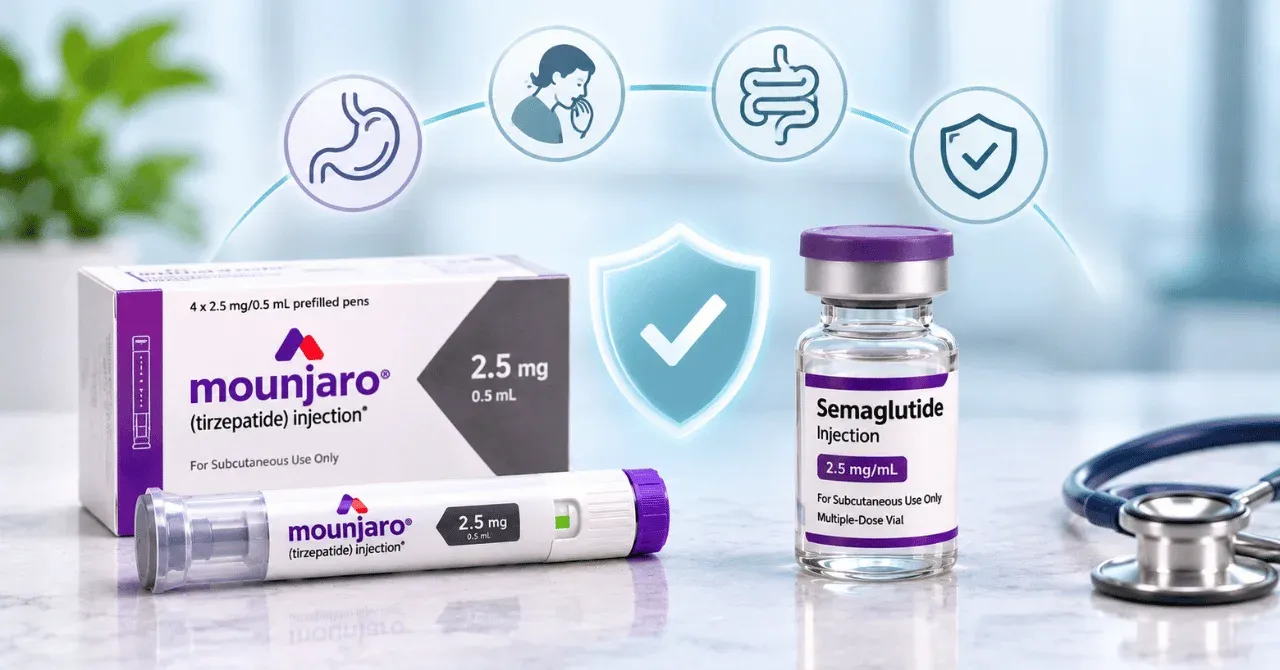
Generic semaglutide for type 2 diabetes is a Health Canada-approved copy of Ozempic, made by Apotex and Dr. Reddy's. It uses the same active ingredient and weekly pen format. One pen covers the 0.25 mg and 0.5 mg doses, and a second pen covers 1 mg.
US patients should know three limits before choosing it:
- It is not FDA-approved. No generic semaglutide is sold in US pharmacies, so US patients can only get it from a licensed Canadian pharmacy with a valid prescription.
- It tops out at 1 mg. People who need the brand Ozempic 2 mg dose for blood sugar control would need the brand product.
- It is not compounded semaglutide. A Health Canada-approved generic goes through a formal approval process, while compounded versions are not reviewed by the FDA for safety or quality. Our guide to generic vs. compounded semaglutide explains the difference.
Is There a Generic Mounjaro?
No. Tirzepatide is still under patent, so there is no approved generic Mounjaro in the US or Canada. Products sold online as "generic tirzepatide" are compounded or unapproved, and the FDA has warned that it does not review those products for safety, effectiveness, or quality.
Mounjaro Cost vs Generic Semaglutide Cost
Price is where the two drugs split most sharply. Each option below comes with its own conditions, so check which ones apply to you.
- Mounjaro list price: $1,112.16 per 28-day fill. Few people pay this in full.
- Mounjaro savings card: as little as $25 for people with commercial insurance that covers it. Without coverage, the card lowers the price to as little as $499 a month. Medicare and Medicaid patients cannot use it, and the current card ends December 31, 2026.
- Medicare: Both Mounjaro and Ozempic are covered for type 2 diabetes under regular Part D plans, with costs set by your plan.
- Brand Ozempic self-pay (US): $349 a month for doses up to 1 mg, or $499 for 2 mg, with no insurance accepted on that program.
- Polar Bear Meds (Canada): Mounjaro KwikPen at $499.99 per pen, which holds four weekly doses at any strength. Generic semaglutide pens are $183.99 per pen. Both need a valid prescription and ship cold in about 3 to 5 business days.
For people paying out of pocket, generic semaglutide is the lowest ongoing cost of the options here. If your insurance covers Mounjaro, the savings card can make it even cheaper.
Which One Fits Your Type 2 Diabetes Plan?
Neither drug is right for everyone. The better pick depends on your A1C goal, your weight goals, your heart and kidney health, and how you pay.
Mounjaro may fit better if you:
- Need a larger A1C drop than semaglutide 1 mg has given you
- Want the most weight loss from a diabetes medicine
- Have commercial insurance that covers it, so the savings card applies
- Are managing type 2 diabetes in a child aged 10 or older
Generic semaglutide may fit better if you:
- Pay out of pocket and need a lower monthly cost
- Have chronic kidney disease, since semaglutide is FDA-approved to slow kidney decline in type 2 diabetes
- Already reach your A1C goal on 1 mg or less
- Want more room for error, since a missed dose can be taken up to 5 days late instead of 4
Switching From Mounjaro to Semaglutide
Many people consider switching from Mounjaro to semaglutide when their cost or coverage changes. Neither FDA label gives a direct dose conversion between the two, so your doctor will choose your starting dose. Starting low and stepping up every 4 weeks, as with any new GLP-1 drug, helps limit nausea. Check your blood sugar more often during the switch, especially if you also take insulin or a sulfonylurea.
Stronger Results or Lower Cost: Weighing the Trade-Off
The Mounjaro vs generic semaglutide choice comes down to what you need most. Mounjaro delivers a bigger A1C drop and more weight loss, while generic semaglutide offers proven heart and kidney benefits at a much lower out-of-pocket price. Bring your latest A1C, weight goal, and insurance details to your doctor, and decide together.
If semaglutide fits your plan, Polar Bear Meds ships Health Canada-approved generic semaglutide pens and brand-name Mounjaro from Canada. Every order requires a valid prescription, and pens ship cold.
Frequently Asked Questions
No. Both drugs work through the GLP-1 pathway, so combining them adds side effect risk without proven benefit. Doctors prescribe one or the other.
No. Mounjaro is a GIP and GLP-1 receptor agonist. It helps your pancreas release its own insulin when blood sugar is high, and it can be used alongside insulin if your doctor prescribes both.
Health Canada approved it as equivalent to Ozempic, with the same active ingredient and doses up to 1 mg. It has not been reviewed by the FDA, so US approval data comes from the brand product.
The generic copies of Ozempic are approved for type 2 diabetes. Using it only for weight loss is off-label, and the semaglutide brand approved for weight management is Wegovy. Talk to your doctor about which fits your goals.
Disclaimer
This article is for informational purposes only and is not a substitute for professional medical advice. Do not start, stop, or switch diabetes medications without your doctor's guidance. Prices and savings programs change often, so confirm current costs before you order.