Tresiba vs Lantus: Which Long-Acting Insulin Is Better?
Key Takeaways
- Tresiba (insulin degludec) works for at least 42 hours. Lantus (insulin glargine) works for about 24 hours.
- Adults on Tresiba can inject at any time of day, as long as doses are at least 8 hours apart. Lantus is taken at the same time every day.
- In a large heart-safety trial, people on Tresiba had 40% fewer severe low blood sugar events than people on glargine, with the same HbA1c.
- Lantus has FDA-approved interchangeable biosimilars. Tresiba has none, but its US list price dropped by more than 70% in 2026.
Both Tresiba and Lantus keep blood sugar steady around the clock, and both lower HbA1c by about the same amount. The real differences are how long each one lasts, how flexible the timing is, and how often it causes serious lows. This Tresiba vs Lantus guide compares them using FDA labels, trial data, and current US costs.
Tresiba vs Lantus: Key Differences at a Glance
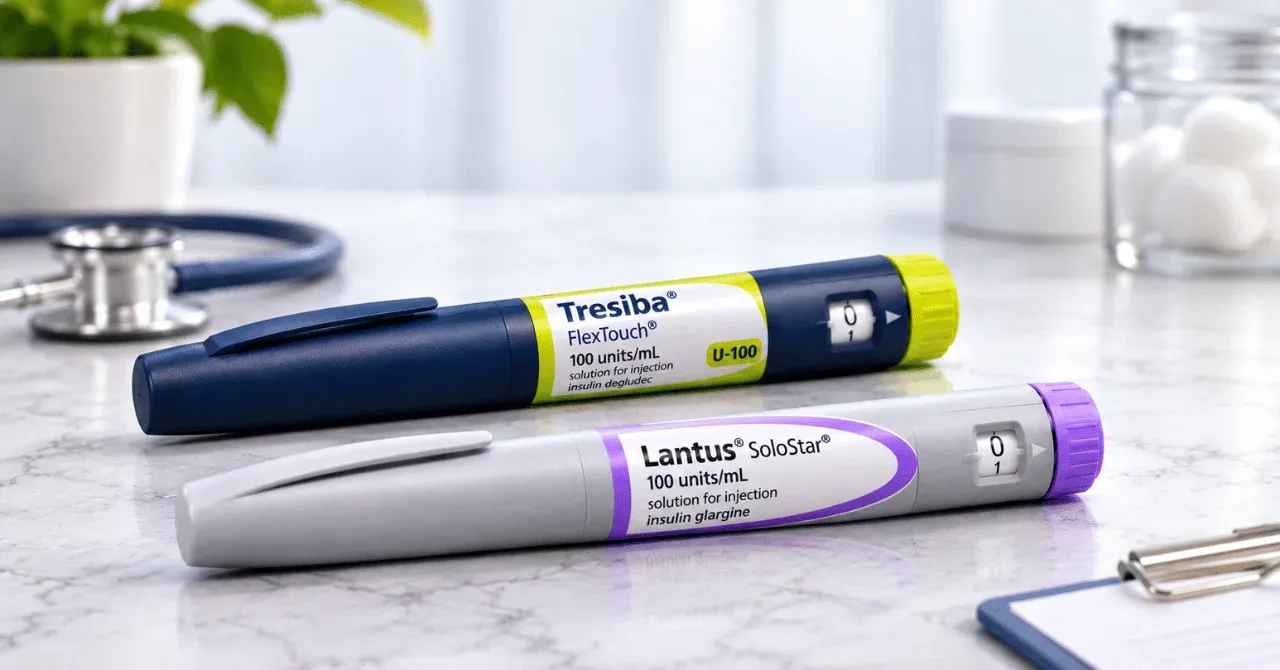
Tresiba and Lantus are both long-acting insulin, also called basal insulin, used for type 1 and type 2 diabetes. When people compare insulin degludec vs insulin glargine, the gaps show up in timing, flexibility, and how long an opened pen lasts, not in how well they lower blood sugar.
| Feature | Tresiba | Lantus |
|---|---|---|
| Active ingredient | Insulin degludec | Insulin glargine |
| Maker | Novo Nordisk | Sanofi |
| How long one dose works | At least 42 hours | About 24 hours |
| When adults inject | Any time of day, at least 8 hours between doses | Same time every day |
| Approved ages | 1 year and older | Adults and children (studied in ages 6 to 15) |
| Forms | U-100 FlexTouch pen, U-200 FlexTouch pen, U-100 vial | U-100 SoloStar pen, U-100 vial |
| Use after opening | 56 days | 28 days |
| Lower-cost versions | No biosimilar | Interchangeable biosimilars such as Semglee |
← Swipe to see more →
The U-200 Tresiba pen holds twice the insulin in the same volume and delivers up to 160 units in one injection. That matters for people who need large doses and would otherwise inject twice.
How Long Each Insulin Lasts and When to Take It
Tresiba's longer action is its biggest practical advantage. Its half-life is about 25 hours, and in testing, its glucose-lowering effect lasted at least 42 hours after the last dose. That Tresiba duration of action is why adults can shift their injection time from day to day.
Lantus gives a steady, peakless level of insulin, but its effect ends at about 24 hours. Because there is little overlap, Lantus works best when you inject at the same time every day, and a late dose can leave a short gap in coverage.
Three details follow from these profiles:
- Missed doses: Adults who miss a Tresiba dose can take it as soon as they notice during waking hours, as long as 8 hours separate it from the next dose. Children on Tresiba should keep a fixed daily time, and parents should call the doctor after a missed dose.
- Dose changes: Tresiba takes 3 to 4 days to reach a steady level, so doctors raise the dose no more often than every 3 to 4 days.
- Daily routine: People with shift work, travel, or irregular schedules often find Tresiba easier to fit in. People who already inject at a fixed time each day may notice little difference.
Tresiba vs Lantus Hypoglycemia Risk and Side Effects
The clearest clinical difference between the two is the risk of severe low blood sugar. The best evidence comes from DEVOTE, a double-blind trial of 7,637 adults with type 2 diabetes and high heart risk who took Tresiba or insulin glargine U-100 (the insulin in Lantus) for about two years.
- Blood sugar control was the same. HbA1c averaged 7.5% in both groups at 24 months. Fasting glucose was slightly lower with Tresiba (128 vs. 136 mg/dL).
- Severe lows were less common on Tresiba. 4.9% of people on Tresiba had a severe low, compared with 6.6% on glargine. The rate of severe lows was 40% lower.
- Heart safety was equal. Major heart events were no more common with Tresiba than with glargine.
DEVOTE studied type 2 diabetes only, so people with type 1 diabetes should talk with their doctor about how these results apply to them.
Otherwise, both FDA labels list the same side effects: low blood sugar, weight gain, swelling, itching, rash, allergic reactions, injection-site reactions, and changes in the skin where you inject. Rotating injection sites lowers the risk of skin changes with either insulin.
Switching From Lantus to Tresiba: What to Expect
Switching from Lantus to Tresiba is usually simple for adults. The Tresiba label tells doctors to start adults at the same number of units as their current total daily long-acting dose, so 30 units of Lantus becomes 30 units of Tresiba. Children aged 1 and older start lower, at 80% of their previous daily dose.
After the switch, expect a short settling period:
- Check your blood sugar more often for the first week or two, since any change in insulin can cause highs or lows.
- Give each dose change 3 to 4 days to take full effect before your doctor adjusts it again.
- Keep your new injection time consistent at first, even though adults can move it later.
The reverse is less standardized. The Lantus label gives switching ratios only from NPH and Toujeo, not from Tresiba, so your doctor will choose your starting Lantus dose. Never change insulins or doses without medical guidance.
Tresiba Cost vs Lantus Cost in the US
The price gap between the two has narrowed. Your actual cost depends far more on your coverage than on the list price.
- Medicare: If your plan covers either insulin, you pay no more than $35 for a one-month supply, and no deductible applies.
- Tresiba cost: Novo Nordisk cut Tresiba's US list price by 72% on January 1, 2026, which brought the monthly list price of the U-100 FlexTouch pen down to about $141. It also stopped selling its unbranded insulin degludec at the end of 2025, so there is no lower-cost Tresiba copy.
- Lantus cost: Sanofi cut the Lantus list price by 78% in 2024 and offers a $35 monthly cap to many commercially insured patients. Eligibility rules apply.
- Lantus biosimilar: Semglee (insulin glargine-yfgn) is FDA-designated as interchangeable with Lantus, so a pharmacist can swap it in without a new prescription, depending on state law. Plans often prefer it.
Polar Bear Meds lists Tresiba FlexTouch at $155 for a box of five pens. For glargine, it carries Basaglar KwikPen at $121 for five pens. Basaglar contains the same insulin as Lantus but is not designated as interchangeable, so your doctor must prescribe it by name.
Is Tresiba Better Than Lantus? It Depends on Your Needs
Is Tresiba better than Lantus? For blood sugar control, neither wins: both lower HbA1c equally. Tresiba pulls ahead on safety and convenience, while Lantus often wins on familiarity and plan coverage.
Tresiba may suit you better if you:
- Have had severe or frequent low blood sugar on other basal insulins
- Work shifts, travel across time zones, or struggle to inject at the same hour
- Need large doses, since the U-200 pen delivers up to 160 units in one shot
- Use a pen slowly, because an opened Tresiba pen lasts 56 days instead of 28
- Are caring for a child aged 1 to 5, the younger end of Tresiba's approved range
Lantus may suit you better if you:
- Are stable on Lantus with no troublesome lows, so there is little reason to change
- Inject at a fixed time each day without trouble
- Have a plan that prefers glargine or a lower-cost biosimilar such as Semglee
Unit for unit, Tresiba is not stronger than Lantus. Adults switch at the same number of units, and the difference lies in how evenly and how long that dose works.
The Right Basal Insulin Is the One That Fits Your Day
Tresiba lasts longer, gives adults a flexible injection time and causes fewer severe lows, while Lantus offers a long track record, a predictable daily routine and cheaper interchangeable versions. Both control blood sugar equally well, so the better choice comes down to your schedule, your history with low blood sugar, and your coverage. Make the decision with your doctor, and never switch on your own.
If you and your doctor settle on a basal insulin, Polar Bear Meds ships Tresiba FlexTouch, Basaglar KwikPen, and Toujeo SoloStar from Canada. Every order requires a valid prescription, and insulin ships cold.
Frequently Asked Questions
No. Both are basal insulins that do the same job, so doctors prescribe one or the other. Taking both would double your background insulin and sharply raise the risk of low blood sugar.
Yes. Tresiba is approved for people with diabetes aged 1 and older, including type 1. In type 1 diabetes, it covers background needs and is used together with mealtime insulin.
Keep unopened pens and vials in the refrigerator. Once in use, Tresiba lasts 56 days either refrigerated or at room temperature up to 86°F. An opened Lantus SoloStar pen lasts 28 days and should stay at room temperature, not in the fridge.
It can. Weight gain is a listed side effect of both Tresiba and Lantus, as it is for insulin in general. Regular meals, activity, and the lowest effective dose help keep it in check.
Disclaimer
This article is for informational purposes only and is not a substitute for professional medical advice. Do not start, stop, or switch insulin without your doctor's guidance. Prices and coverage rules change often, so confirm current costs with your plan or pharmacy.